Showing posts with label phenomenological. Show all posts
Wednesday, July 1, 2015
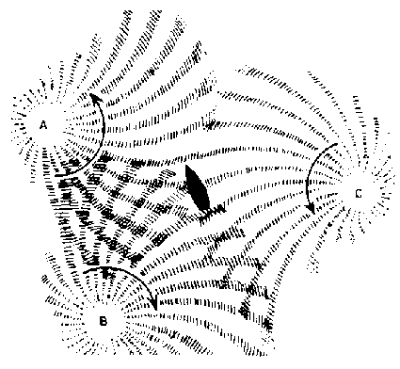
municipal utility markers vs. light wheels
Here are two things I've been research and collecting - they don't necessarily go together, but I find that it is sometimes productive to let things overlap in order to create new meaning(s). I am interested in both at the same time anyway.
Labels:
"Strange Phenomena",
light,
phenomenological,
utilities
Thursday, June 18, 2015
ball lightning dance
GLB-064 BALL LIGHTNING AT ALPENA, MICHIGAN
Anonymous; Nature, 126:153, July 26, 1930.
August 1, 1907. Ball Lightning of Alpena, Michigan.---On August 1, 1907 during a heavy shower with thunder and lightning, a ball of lightning about six to eight inches in diameter entered a house. It dropped lightly to the floor, moved round the room in circles, then entering the wall, moved up inside it and came out a few feet above the window. A four-inch brace was splintered and much plaster was forced into the room. The ball then travelled across the room again and out the other wall, making a ragged hole. It struck into the earth about 30 feet from the house, leaving a hole about 6 inches wide an a few inches deep.
-from Strange Phenomena: A Sourcebook of Unusual Natural Phenomena, compiled by William R. Corliss, 1973
Monday, May 9, 2011
Glowing Steps
 
GLD-013 [LUMINOUS FOOTPRINTS]
Anonymous; Nature , 12:564, October 28, 1875.
      A correspondent of the Aberystwith Observer, the Rev. James Lewis, of Llanilar Vicarage, writes as follows to that journal:
-from Strange Phenomena: A Sourcebook of Unusual Natural Phenomena, compiled by William R. Corliss, 1973
GLD-013 [LUMINOUS FOOTPRINTS]
Anonymous; Nature , 12:564, October 28, 1875.
      A correspondent of the Aberystwith Observer, the Rev. James Lewis, of Llanilar Vicarage, writes as follows to that journal:
--"whilst returning from service at the parish church of Rhostie, at about 8.15 p.m. on Friday, the 24th ult., in company with two members of the congregation, my attention was called to a remarkably strange phenomenon. In walking across a field on the farm of Cwmclyd, it was noticed that our footsteps were marked by a peculiar light, which could be traced back for several yards, each footprint being as distinctly marked on the ground as when one walks in snow. When we got into the adjoining field the light disappeared until we came near to the end of it, when it was observed that our footsteps were again marked by the same luminous appearance. In colour the light was similar to that of phosphorus rubbed on a wall in a dark room, or a mass of glow-worms, or which insect, however, there was no trace on the surrounding ground."Since no electrical storm or other atmospheric effects were mentioned, this luminous phenomenon may be chemical or biological in origin. There are, however, cases of terrain made luminous by some sort of electric discharge phenomenon.
-from Strange Phenomena: A Sourcebook of Unusual Natural Phenomena, compiled by William R. Corliss, 1973
Saturday, May 7, 2011
Fiery Whirl
  
GLD-040 THE NOTES OF CHARLES FORT
Fort, Charles; The Fortean Society Magazine, 1:12, Spring 1944
      August 26, 1826. Fiery whirl. Carcassone (Aude), great heat in the morning. At noon massing clouds in the west. Then a thick black cloud suspended over a field. Crackling and hissing and air rushing toward the cloud. A loud detonation and an enormous column of fine hovered the field--throwing down walls and picking up and killing sheep. A strong sulfurous odor. Nobody said it burned anything.
-from Strange Phenomena: A Sourcebook of Unusual Natural Phenomena, compiled by William R. Corliss, 1973
(same source as in this post)
Tuesday, April 26, 2011
Ball Lightning, an account
 
GLB-048 A FIRE-BALL
Hunneman, Mary E. ; Science, 86:244, September 10, 1937
      The electrical phenomenon know as a "fire-ball" is rather a rare occurrence. Therefore one that I saw at Fitzwilliam, New Hampshire, at 5 p.m. on August 10 may be worthy of record. I was seated on a second story porch enclosed with glass watching the storm. A radio aerial extends from a distant tree to a point on the side of the house some distance from the porch. Coincident with a crash of thunder, a fire-ball appeared. I cannot say that it followed the wire or came from the sky. It just came out of space and seemed to move directly toward the window and then fell as though to enter the cellar of the house. It was a round, bronze, glistening ball with gleaming rays shooting from the top and sides; by its beauty and brilliance reminding one of an ornament at the top of a Christmas tree. Such was my fleeting sight of a fire-ball. Probably at the same instant, all electrical fuses in the house blew out with unusual violence.
-from Strange Phenomena: A Sourcebook of Unusual Natural Phenomena, compiled by William R. Corliss, 1973
Sunday, February 14, 2010
Aspen Mays and the Stars
"To find your way among the stars, choose some familiar pattern
as a starting point and gradually work your way from one star
group to another."
Menzel, Donald H. A Field Guide to the Stars and Planets. Boston: Houghton Mifflin, 1964, p. 104.
Aspen Mays - Jellybean Universe (jellybeans and jar, on a locker) from her exhibit "From the Offices of Scientists" at the Hyde Park Art Center
The work in Aspen Mays' exhibition "From the Offices of Scientists" at the Hyde Park Art Center comes from direct observations she made at the Adler Planetarium in Chicago while presumably making the video, Larry. The pieces in this show (Jellybean Universe seen above) depart from Mays familiar medium of photography. Sculpture, installation, and only one sculpture-like photograph, You're Next populate this show. The pamphlet accompanying the exhibition states,
"By applying creative license to astral discovery, Mays emphasizes those moments where humor, humbleness and big ideas meet and restores the basic sense of wonder the cosmos have instilled in humans since the beginning of time."
-Allison Peters Quinn, Director of Exhibitions, Hyde Park Art Center.
As I organize and write for the two person (me and Erica Moore) exhibition "Polaris" at Ainsworth Gallery in Joliet, IL I can't help but think that Aspen Mays has beat me to my own punchline. In the "Polaris" exhibition Erica and I are focusing on the mystery and draw of space as inspiration, and as a metaphor for creative practice in relation to the above quote from Donald Menzel. I loved this exhibition for its attempt to represent the grand and phenomenological in human terms and its attention to objects and their meanings and I can only hope that Aspen may read this and want to be my friend.
Aspen Mays - Planet Boxes (cardboard document boxes) 2009
as a starting point and gradually work your way from one star
group to another."
Menzel, Donald H. A Field Guide to the Stars and Planets. Boston: Houghton Mifflin, 1964, p. 104.
The work in Aspen Mays' exhibition "From the Offices of Scientists" at the Hyde Park Art Center comes from direct observations she made at the Adler Planetarium in Chicago while presumably making the video, Larry. The pieces in this show (Jellybean Universe seen above) depart from Mays familiar medium of photography. Sculpture, installation, and only one sculpture-like photograph, You're Next populate this show. The pamphlet accompanying the exhibition states,
"By applying creative license to astral discovery, Mays emphasizes those moments where humor, humbleness and big ideas meet and restores the basic sense of wonder the cosmos have instilled in humans since the beginning of time."
-Allison Peters Quinn, Director of Exhibitions, Hyde Park Art Center.
As I organize and write for the two person (me and Erica Moore) exhibition "Polaris" at Ainsworth Gallery in Joliet, IL I can't help but think that Aspen Mays has beat me to my own punchline. In the "Polaris" exhibition Erica and I are focusing on the mystery and draw of space as inspiration, and as a metaphor for creative practice in relation to the above quote from Donald Menzel. I loved this exhibition for its attempt to represent the grand and phenomenological in human terms and its attention to objects and their meanings and I can only hope that Aspen may read this and want to be my friend.
I have only a few questions or critiques of Aspen Mays' exhibition: what is up with the dolphins in The Moon and where is the monitor and CPU in Boulder Desk? As well as ask, do these pieces generalize the "scientists" that she observed into a generic form? These things aside I want to say that this is a beautiful show.
Tuesday, February 9, 2010
Light and Phenomenology at 2700°K
"To be freed from this bondage [of Plato's cave], to be liberated, is thus to be brought into the light, for it is through light, sunlight, that the world, and our situation in it becomes 'unhidden'... We also remember that the prisoners in the cave stand for our situation in the world, then we can see that the fire represents the Sun, which is confirmed by Plato himself towards the end of the allegory."
-Gertz, Nolen. from Toward a Phenomenology of Light.
"There is indeed brightness, 'light', inside the cave, but from behind. The prisoners have no relationship to light as light, for neither do they see the fire that casts the light. [...] All this, things that cast shadows, fire that makes shadows possible, is opisthen, behind their backs, as distinct from ta prosthen, what they see before them. Only the latter is unhidden' the former remains hidden. Here, therefor, being human also means, among other things: to stand within the hidden, to be surrounded by the hidden..."
-Heidegger, Martin. The Essence of Truth (New York: Continuum, 2002), p. 12.
"In our original situation in the cave all we see is shadows, but that they are shadows is 'hidden' from us, for we do not see what they really are. It is not until we become aware of this distinction between seeing as seeing and seeing as knowing that we can see things properly. [...]
If the fire in the cave represents the actual Sun and its light represents the mundane way of seeing things, then the seeing of Ideas is represented by the light outside the cave and that highest of Ideas for Plato, the Idea of the Good, is what is represented by the Sun."
-Gertz, Nolen. from Toward a Phenomenology of Light.
This in line with my interest in light and a recent piece I finished. At the top is the chart I made so I would wire the fixtures correctly and below is a detail image of the piece. More images are on my website.
2700°K (light bulbs and light fixture) 2010(refer to earlier posts Big Bang and Big Bang 2 for more info on the evolution of this piece)
Labels:
electricity,
light,
myth,
Nolen Gertz,
phenomenological,
Roland Barthes
Monday, January 18, 2010
owl and mirror

I built an owl today; from the Owl Puzzle that I bought yesterday. I spray painted a different color on each side of the 4 sheets of balsa wood before I popped the pieces out. The construction was a little more complicated than I expected; mostly because the instructions, diagrams, and photo were vague.
ASSEMBLY INSTRUCTIONS
PLEASE READ THE INSTRUCTIONS CAREFULLY
1. First, carefully push out each piece from the wood board.
2. Before assembly, use the enclosed sandpaper to smooth all rough edges.
3. Get [sic] general idea of where each part goes by referring to the front photograph and the diagram below.
4. Put all parts together by following the right order of numbers shown on the diagram. Join pices by interlocking the exact two areas together that have the same number (1 to 1, 2 to 2, 3 to 3, and so on).
5. Glue can be used to assemble kit permanently. Glue is not included.
6. Before or after assembly, stain, varnish or paint can be applied on the wood according to personal choice in color and design.
7. String included for sails. After assembly of boat, lace string through holes noted by number in black circle (give example of number in black circle) on diagram on the right. Start with #1 and lace to #2 then to #3 and so forth. [evidently step 7 is an unedited step for a sail boat puzzle, and is included here by mistake]
With instructional issues aside, the owl has been made. For me, he is a magical owl. Flat pieces of wood that existed only as abstract shapes in the wood boards have been transformed into detailed feathers and body forms. The magic here is three-fold.
Working on this I understand the puzzle in a variety of ways: artistically, as a brainteaser, and as a playful child-like fascination with objects and games (similar to Legos). The latter is a quality of mine that I hopefully will never loose. I often feel like I am my current age (26) and 12 simultaneously. So on one level this puzzle is a game, and fun!
Secondly, through art, the owl addresses culture within it's mystical transformation from raw materials (cheep wood and spray paint) into a signifying object.
In the owl's last move he references a personal history. When I was in Boy Scouts I could sometimes hear owls calling to each other late at night. This only happened when our troop was camping deep in a scout reservation, well away from buildings and lights. Through seclusion and unfamiliarity these places were already mystical in their own right. The owl seemed to be an invisible watcher-protector of the forest. The following is a description of the Barred Owl (Strix varia), the most common owl in Illinois.
"Voice: A loud, barking hoo, hoo, hoo, hoo, hoo, hoo-hooo-aw!; a variety of other barking calls and screams.
...
This owl is seen only by those who seek it out in its dark retreat, usually thick grove of trees in lowland forest. There it rests quietly during the day, coming out at night to feet on rodents, birds, frogs, and crayfish. If disturbed, it will fly easily from one grove of trees to another."
-John Bull and John Farrand, Jr. The Audubon Society Field Guide to North American Birds, Eastern Region. New York: Alfred A. Knopf. 1977. 634-635.
I placed the mirror behind the owl to show his back. This move has led me to some other questions about mirrors that I have been thinking of in other pieces. The following poem speaks to some of my interest in mirrors and mirroring effects as well as the sound of owls communicating across a forest.
Kenneht Koch
Aesthetics of Echo
Echo was............................Us
A nymph who lived in.........Din
Every Cliff..........................If
Owl (cardboard, wood, hot glue, acrylic, spray paint, glitter, sharpie, plastic rhinestones) 65" x 6" x 6" 2008Some other work with/about owls from my image library:
Joseph Cornell - Untitled (Lighted Owl) (assemblage) c. 1949
Brian Kapernekas - Owl (mortar, pigment, straw, horsehair, twine, wood and nails) 2007
Gabriel Orozco - Owl (photograph) 1993
Roni Horn - Dead Owl (2 iris printed photographs) 1998
Ashley Morgan - Collar Bones (bones from owl pellets and glue)Thursday, January 7, 2010
I took this photo in my old apartment. I own 2 small tear shaped prisms (the type found in road-side gift shops) and one of them was making awesome rainbows in the living room one morning. This spectrum was hitting a cigarette wrapper (the plastic and paper) that my roommate had left on his gray plastic shelving unit. The cigarette paper is reflecting the blue light onto the shelf (seen to the left of the wrapper). Like the opalescent gift tissue in my piece The Mystery of Sprites and Jets the reflective surface of the paper absorbs all colors except for one. In this photo blue in reflected; in Sprites and Jets green (to a lesser extent yellow and blue) are reflected.
The mystery I am addressing in the above pieces is the enactment of light; what light can do. There is a certain cultural fascination with light and light effect (black lights, strobe lights, night lights, fireworks, Christmas lights, northern lights, etc) that I share and am interested in dissecting and altering into surprising and new displays of objects, color, and light. In Sprites and Jets the mystery is exemplified by the title referent: the electrical storm effects (similar to lightning, but above the clouds) called red sprites and blue jets.
The reference to the meteorological effect was first by aesthetics (the colors are similar), but was soon followed my mystique. Before they were widely know airplane pilots often commented on these strange occurrences that happen only during electrical storms; a weather condition that already came with it's own awe and other-worldly experience. Not much is known about the characteristics, function, or cause of sprites and jets still.
The added magic of this upper-atmosphere event was a welcome and planned addition to my interest and display of 'light doing weird things' in the above mentioned photograph and sculpture. I feel that the humble way (through poor and commercial material and size) I am addressing these grandiose concepts in a surprising and refreshing way. Stepping back, what I'm really saying is' "garbage can be magical too!"
Below are some images of a few pieces I've recently come across by Charles Ross and Nancy Holt that I like to think of in concert with my above mentioned ideas. [although artists like James Turrell, Olafur Eliasson, Robert Irwin, Dan Flavin, Spencer Finch, Felix Gonzalez-Torres, and a host of other people (mostly men and modernists evidently) could be mentioned here too]
Labels:
color,
light,
modernism,
phenomenological,
spectrum
Monday, December 28, 2009
List made in Coal City, IL and Florence, MA
phenomenological - personal
ephemeral - eternal
home - near
humble - transformative
everyday - everyday
myth - spirit
home - near
humble - transformative
everyday - everyday
myth - spirit
birth - death
Subscribe to:
Posts (Atom)